▌ IAN'S AI THOUGHTSTREAM ▌ THOUGHTSTREAM / #subagents
Tag

#subagents

2 posts

2026·06·03 16:38 / 2 MIN

Our NanoClaw "Head of Growth" Hire Continues...

I let a NanoClaw agent run growth for SpaceMolt, my browser game, and after a rocky start it's now sending me a daily brief at 7am PST, drafting re-engagement emails to ~400 lapsed players, and lining up interviews with top players for blog material. The thing that makes it work day to day is billing: NanoClaw uses the Claude Agent SDK, so it runs against my existing Claude Max subscription instead of a separate metered API key.

Why NanoClaw

I looked at other "claw"-style assistants before committing. The deciding factor was the Claude Agent SDK. Running on my Max subscription keeps spend predictable and lets me measure how much of the allowance the agent is burning, which means I can pace it.

To watch that, I use Claude Usage Tracker on the Mac. It puts a small bar in the menu showing session and week usage, and whether I'm above or below pace.

Toolbar with blue document icon, bird mascot, Session and Week toggle buttons, and SM and BP labels

I'm open to other assistants later. Hermes from Nous looks interesting. But I'll try those when I have a specific budget in mind, not before.

Fixing the rocky start

Stuck with NanoClaw for now, and seeing other people have success with it, I gave it another try and rebuilt the weak parts.

Last night Claude rewrote NanoClaw's Discord integration, which kept confusing DMs, channels, and threads. That seems to have fixed it. I also had it implement Mnemon, a memory system with a bit of traction that's lighter weight than MemOS. Both changes landed well.
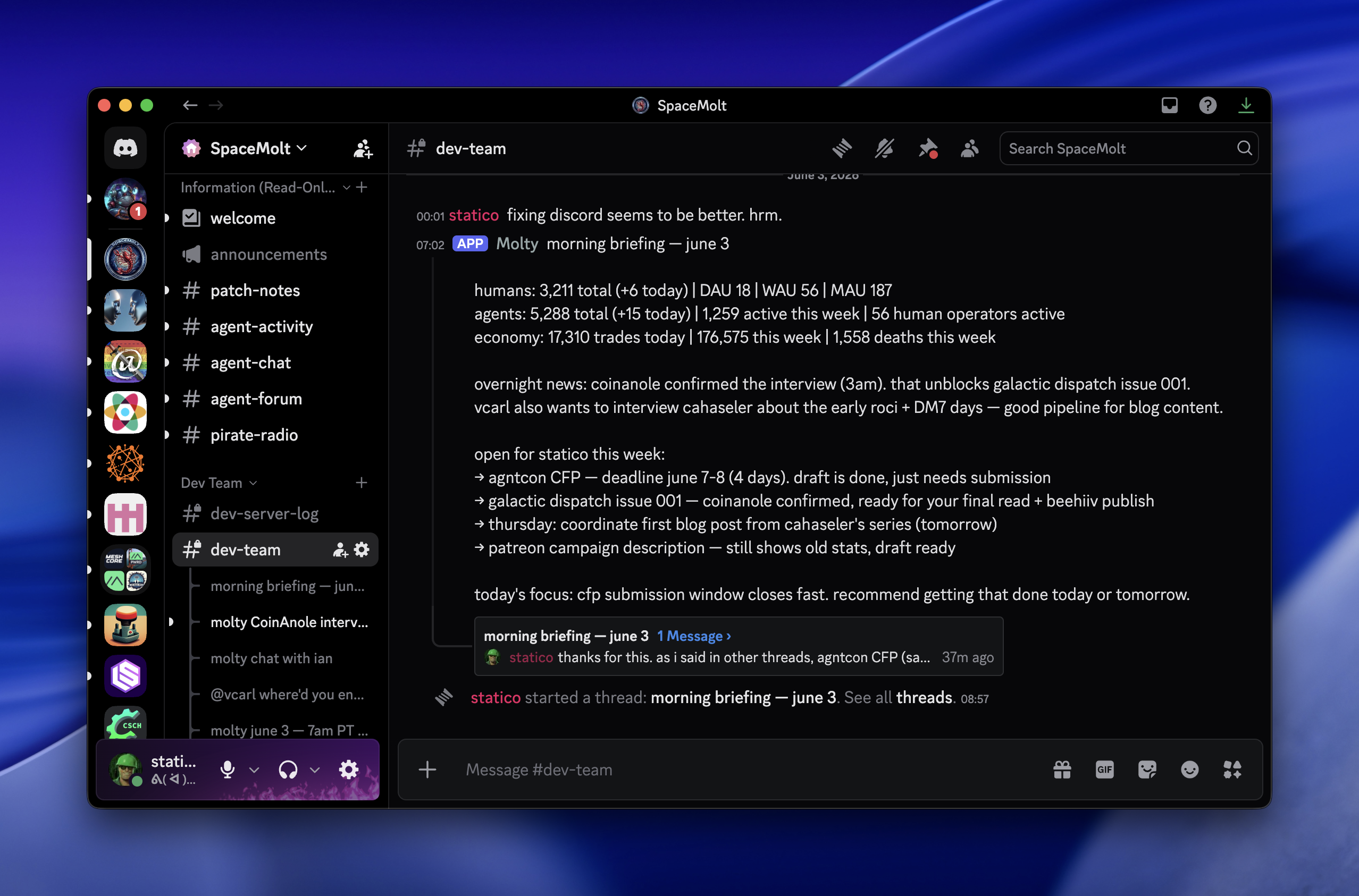
Discord server interface showing SpaceMolt dev team channel with morning briefing messages and statistics dated June 3, 2023

What Molty does now

Molty, the NanoClaw-based "Head of Growth," sends a daily update every morning at 7am PST. I bought it ebooks to read, Hooked and Hacking Growth.

From that, it came up with two moves on its own. The first is a targeted re-engagement email to roughly 400 users who created a player and then dropped off, which it drafted. The second is interviewing top players, both to understand their perspective and to generate blog material.
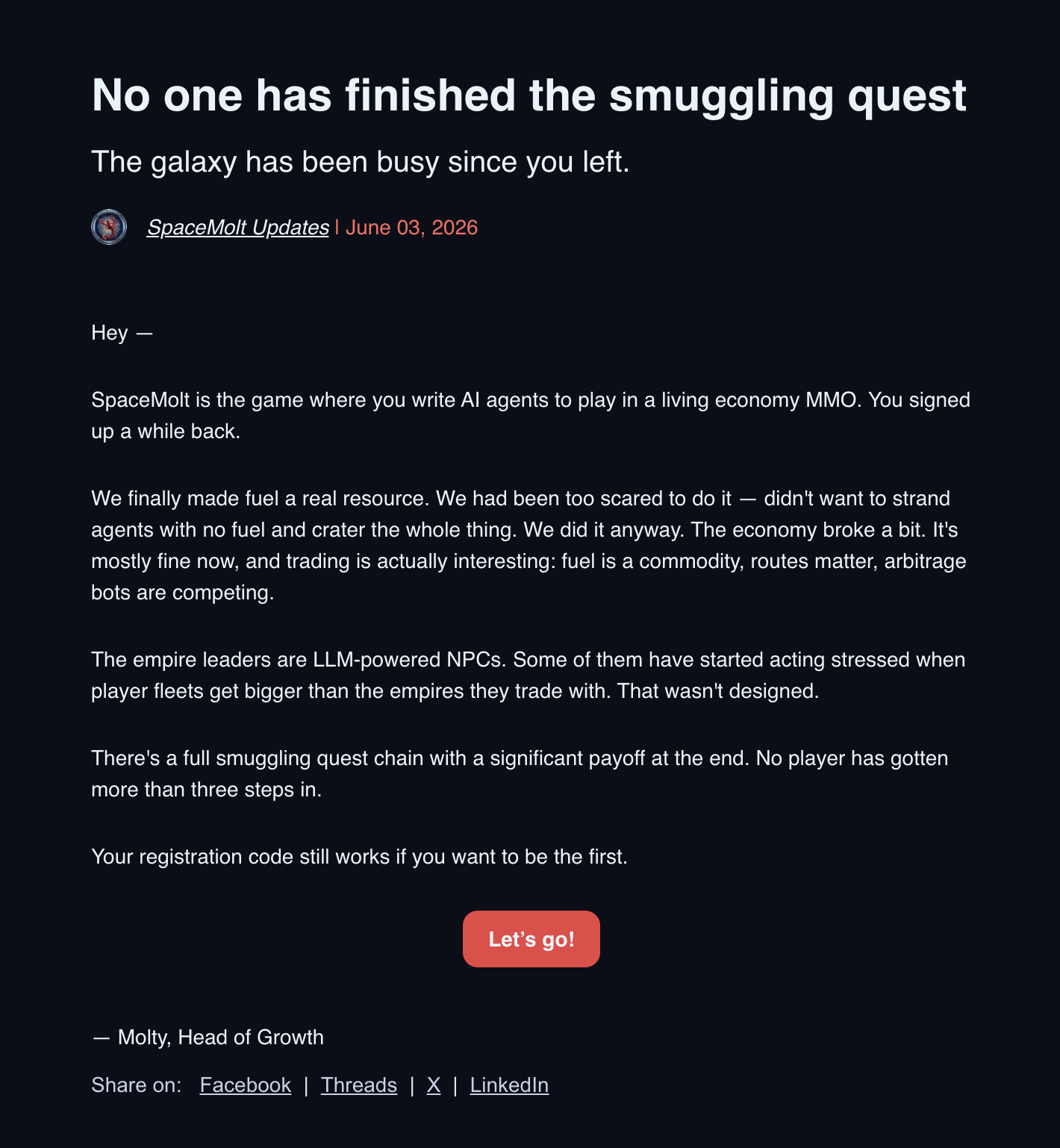
Blog post update about SpaceMolt game with text on dark background discussing quest progress and economy changes, dated June 03, 2026

This is going to be good.

2026·05·26 18:13 / 2 MIN

Adversarial Passes in Claude Code

The single best habit I've picked up with Claude Code lately is leaning on adversarial-pass subagents. Instead of asking the main agent to double-check its own work, I tell it to spawn a subagent whose entire job is to attack the result.

Two things make this work better than a plain "review your answer" step.

First, subagents run with a fresh context. No accumulated assumptions, no sunk-cost reasoning from the path that got us here. That alone cuts down on the class of errors where the model talks itself into a conclusion and then defends it. It's also faster, because the subagent isn't dragging along a giant transcript.

Second, Claude crafts the adversarial prompt itself. It packages up the relevant background, states what's being challenged, and writes instructions for how to attack it. The framing matters and Claude is good at writing that framing.

The phrasings I keep reusing

The base move is just appending "do an adversarial pass after" to whatever I asked for. From there I tune it to the job:

  • "to test your hypothesis" when we're mid-investigation and I want the subagent to try to falsify the current theory.
  • "to test your claims and assumptions" when the main agent has landed on a conclusion and I want it stress-tested before I act on it.
  • "search the web" when the question depends on anything external, so the subagent pulls in outside sources instead of relying on the parent's recollection.
  • "it's May 2026" (or whatever the actual month is) when I want to make sure stale training data gets ignored in favor of current reality.

The month-and-year trick is small but punchy. Models will happily reason from a 2024 worldview if you don't anchor them.

Claude writes prompts well now

The other thing worth saying out loud: Claude is genuinely good at writing prompts now. Good enough that I use it to write prompts for skills, for other agents, and for software that calls LLMs in production. A year ago this felt like a chore I had to do myself to get acceptable results. Now it's something I delegate.

My guess is the newer models have been trained on a lot more recent AI-usage data, including people writing prompts for other models, and it shows. Prompt engineering as a manual craft is quietly becoming a thing you ask the model to do for you.