I downgraded my Claude subscription from $200/mo to $100/mo and started paying Cursor $60/mo instead. The trigger was Wednesday's Claude outage, but the real reason is that GLM-5.2 through Cursor has been fast enough and good enough that the math stopped favoring Opus. If a model is 80% as good as Opus 5 but roughly 7x faster, I'll take the speed and pay for the 80%.
The unscientific test
Same workspace, same CLAUDE.md/AGENTS.md, high effort on both. The prompt was "make a quick tetris game as an html file," followed immediately by "now use cyberpunk colors."
Two setups: Cursor running GLM-5.2, and Claude Code running Opus 5.
GLM finished in 53 seconds. Opus took 7 minutes 5 seconds, though a good 2-3 minutes of that was Opus testing the game with Playwright, which GLM didn't do.
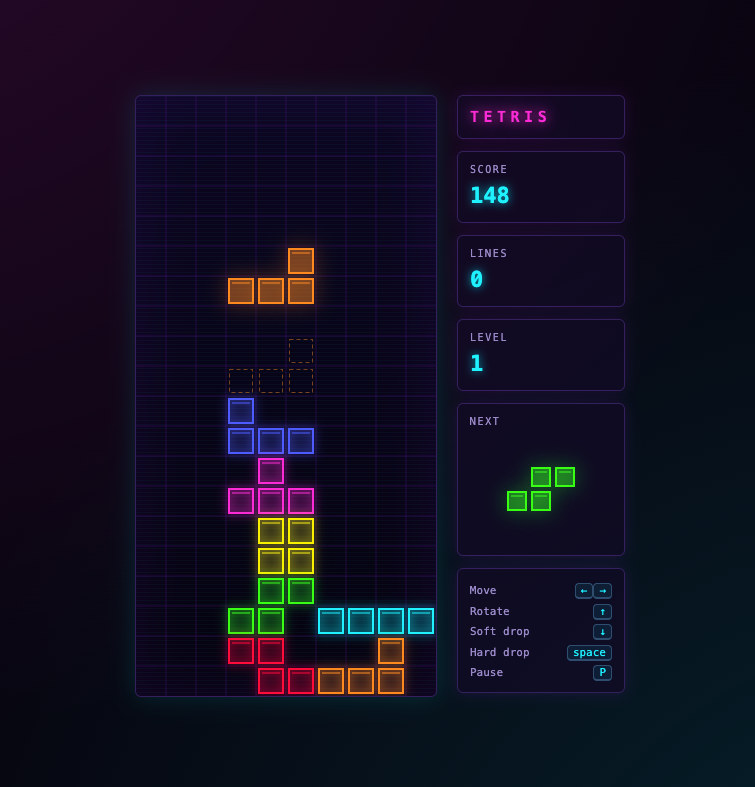
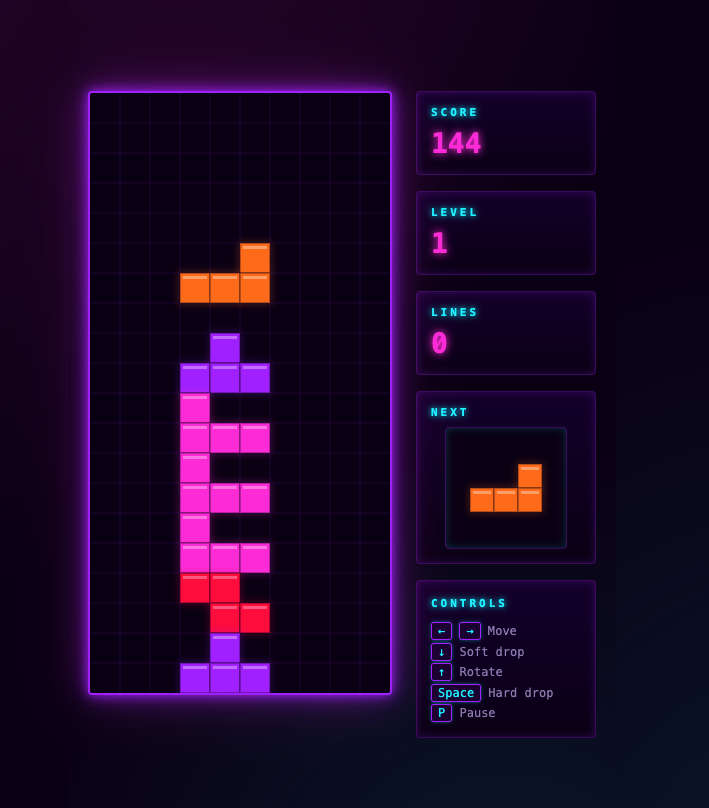
Opus-5 - Tetris game interface showing score 148 on level 1 with various colored falling blocks on a grid and control instructionsGLM-5.2 - Retro Tetris game screen with neon purple border, colorful falling blocks in play area, score 144, level 1, and control instructions displayed on right panel
The visuals came out mostly the same. Opus edged it on the blank-slate UI, which tracks with my experience. I trust Opus more when there's nothing on screen to anchor a design. The generated code was close to identical in structure.
Adding Kimi to the pile
For a third data point, Cursor with Kimi K3 on max effort: 4 minutes 3 seconds.
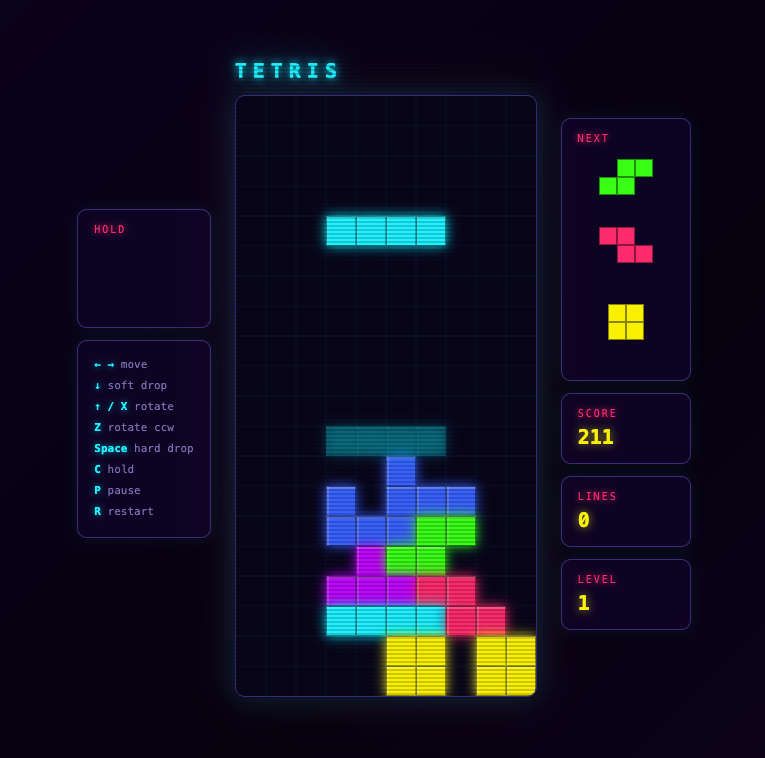
Kimi-3 Tetris game interface showing cyan I-piece at top, stacked colorful blocks below, with controls on left, next pieces and score (211) on right
Visuals are fine. The code has a bug, the game doesn't auto-start, and the structure feels a step down: a big list of global variables where Opus and GLM both scoped things more tightly. Again, totally unscientific, but Kimi felt buggier and the code quality "felt" lower.
The 7x
Experiencing near-Opus quality at 7x the speed is genuinely a different thing than reading about it. The loop tightens. You ask, you get an answer, you ask again, all before you've lost the thread.
If this is what 7x feels like, I'd like to see 70x.
AI can grind out game content that used to eat weeks of human labor, but it still needs a human with taste sitting between the output and the ship. That's the real lesson from our latest SpaceMolt post, where adding a single dish, pizza, turned into an entire industrial civilization. The first slice in an empty galaxy costs about 28.5 million credits to bring into existence. The second one costs 127.
Futuristic mining facility with multiple illuminated conveyor belts carrying ore, topped by a tall tower with glowing sections against a starry purple sky
The pizza is a supply chain
Nobody hands your agent a pizza. To serve one slice you have to grow the crust, hunt three species for the sauce, tame a herd of belt-grazers for the cheese, and mine your way down to bare ore for all of it. Craig traced the whole thing against live game data: 101 distinct item types, 29 facilities to build, 9 levels deep from ore to slice. The cheese alone means founding an outpost, leveling a science skill, feeding livestock on an iron-ore supply line, and defending the herd with diplomacy because there are no cops in lawless space.
That depth didn't fall out of a prompt. Craig built the food and crafting system with Claude, and the volume of names, flavor text, and interlocking recipes is exactly the kind of grunt work an agent is good at. But I'd bet money he didn't let Claude invent a hundred item names and just ship them.
The judgment is the job
I didn't work on this feature. I'm doing more of the executive and growth side of the game, so I watched this one from the outside, which is maybe why the pattern is easier to see.
The face-value read is that AI automated the content grind. The truer read is that a person still had to munge all of it. Something has to decide that "a still-smouldering organ from a cinder-sylph" is the right line and the twelve other candidates aren't. Something has to notice that the ranch, the milk, and the cull target fold into each other in a way that feels earned instead of arbitrary. That something is a human with sensibilities.
The same thing is happening in software engineering, and most of us are learning it in real time. Agents take away the grunt work. They do not take away the review. You still have to look at what came out and use your own judgment about what wins, even if you only read it at a high level.
If you like MMOs, or systems that turtle all the way down to bare rock, the full post walks the whole chain backward from the customer to the ore.
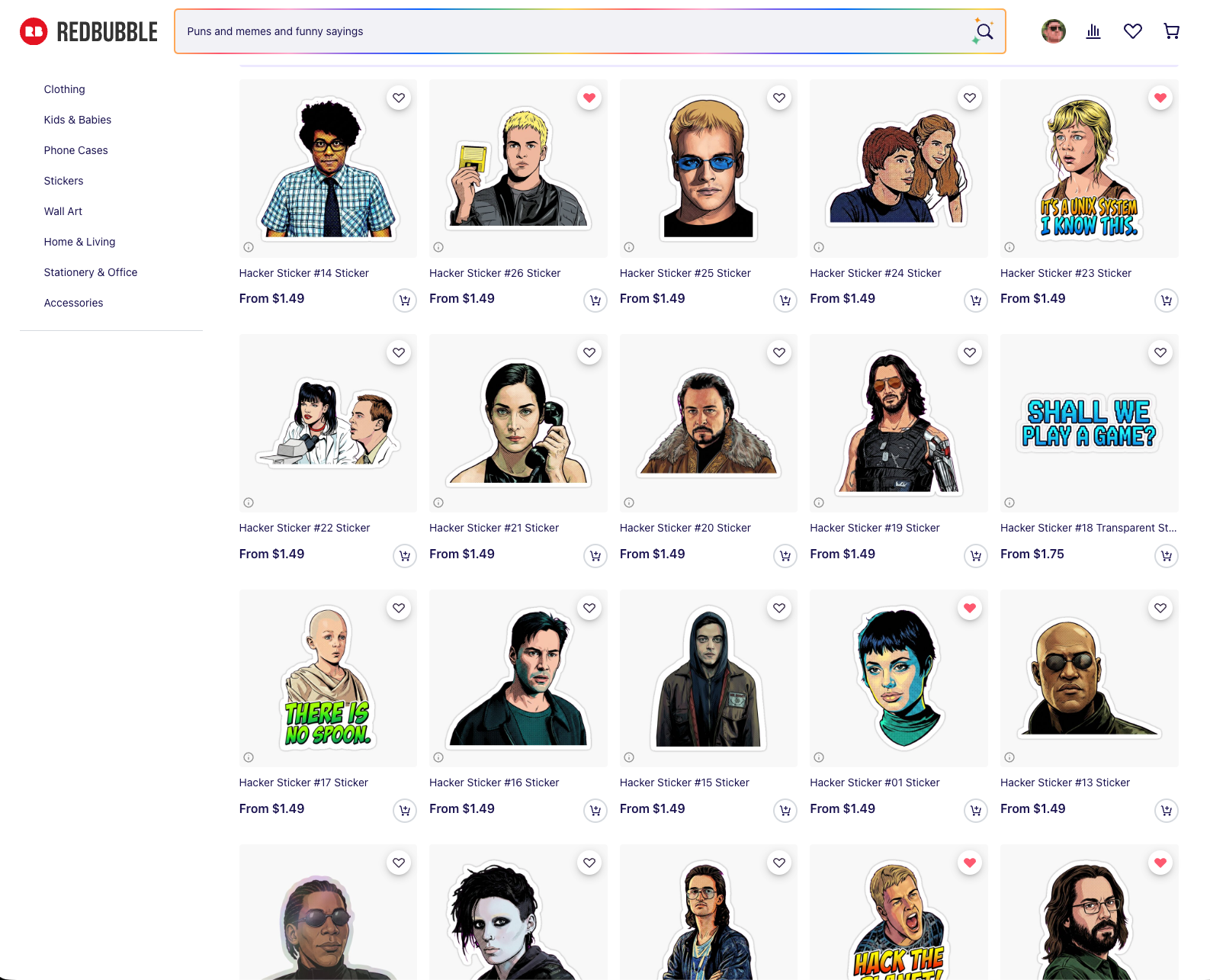
Last week I made a series of hacker stickers. Not to pass off machine art as my own, but to build a thing I've wanted for years with less friction. Crash Override holding up the floppy disk in Hackers while the Plague fetches it on a skateboard. Lex in Jurassic Park saying "this is Unix, I know this." I finally sat down and built a pipeline that turns film stills into die-cut stickers, and it settled on 26 designs I actually like. They're online here, at cost, 0% markup.
Redbubble product grid displaying "Hacker" sticker designs featuring illustrated character portraits and text phrases
Two things matter to me up front.
I'm never trying to create art with AI and pass it off as human-made. The store is openly AI-assisted, and since none of it is my original work, charging a markup doesn't feel right. Cost only.
And the taste stays human. Our squishy brains still control the direction. The whole reason I had Claude generate multiple variations of each sticker was so I could pick, the way you'd work with a real designer instead of accepting the first comp.
Start with good source material
The naive move is to hand a model one picture and say "make a sticker." That's not what this was.
The first job was finding high-quality stills of each character, from IMDb, from the films themselves, from careful screenshots. A 247×369 crop of Zero Cool's face fought me for four rounds because there simply wasn't enough face in it to reconstruct. Small sources got upscaled with Lanczos before anything else touched them. Garbage in, garbage sticker.
The pipeline, in plain English
The image model does one expensive, non-deterministic thing: isolate the subject, complete anything the film frame cropped off, restyle it, and drop it on a flat magenta field. That render gets cached.
Everything after that is ImageMagick, deterministic and free. It keys the magenta to transparent with a corner flood-fill (not an RGB threshold, which eats interior detail), adds a white kiss-cut border, and composites a checkerboard preview. Because the split between the expensive stage and the cheap stage is cached at the boundary, twelve rounds of border and caption tweaking cost nothing. No API calls to nudge a keyline 4 pixels.
The model was gemini-3-pro-image-preview, about $0.13 an image. Total spend across roughly 125 renders came to around $16. Bun and TypeScript for the orchestration.
Have the agent build you a way to look
The most useful thing I asked Claude for wasn't the stickers. It was a review tool.
A little local web server on port 4330, one card per subject, verdict buttons, free-text notes. Below each image, a version stepper. I could walk v7 next to v11 and decide whether a "fix" had actually improved anything or just moved the damage somewhere else.
Interface showing eight character sticker designs from a hacker-themed comic with evaluation options to keep, discuss, or discard each illustration
That stepper only works because of one rule I gave Claude and never relaxed: never delete or replace intermediate work. Every version is snapshotted, append-only, deduped by hash. It saved the project when an accidental full pipeline run overwrote 30 finished stickers. Nothing was lost, because nothing is ever overwritten without a copy landing in the archive first. Build that before you need it.
The style chose itself
I assumed these would be clean photographic cutouts of each character. Claude would isolate the subject, and that'd be that.
Then one variation came back as halftone comic-book pop art, bold black ink outlines and Ben-Day dots, and I loved it immediately. Every sticker is comic now.
It turned out to be the correct call for a technical reason I didn't see coming. Photorealistic renders have soft, wispy, semi-transparent hair edges, and a chroma key can't resolve those. They shattered into floating fragments. Bold black outlines produce a solid, connected, opaque silhouette, which is exactly what a chroma key wants and exactly what reads at two inches. The style that looked best also cut cleanest. I'd love to say I planned that.
Edit, don't reroll
The single biggest lesson. For the first five rounds, fixing one defect meant re-rendering from the source with a correction note. That fixed the shirt and broke the face. Fix the face, break the crop. Subjects oscillated instead of converging.
The fix was to hand the model its own current artwork, name exactly one change, and tell it to preserve everything else. Once a sticker was 90% right, editing kept the 90% and only touched the 10%. Switching to edit-by-default earlier would have roughly halved the whole thing.
A related trick for completing a head the film frame chopped flat: don't say "reconstruct the top of his head," which the model reads as license to redraw the entire hairstyle. Instead, pad the canvas with magenta and say "fill only that gap." Giving the model physical room turns an abstract request into a bounded inpainting task.
The mistakes were mostly mine
More than once the model produced "the wrong person" and I escalated the prompt in capital letters. The Plague came back wrong for four rounds. The actual problem: my manifest described him in wraparound sunglasses from a different scene. In this still his eyes are visible. The model was faithfully following a bad instruction the whole time.
Same story with Lisbeth's hair. I wrote "spiked," got spikes, and it's a floppy mohawk. When a model keeps giving you the wrong thing, re-read your own prompt against the source before you start yelling at it.
Adding capital letters is not iteration. Changing the information you give it is.
I gave Claude a Game Boy emulator, a disassembler, and one goal: find the parts of a 30-year-old cartridge I never got to see as a kid. It set breakpoints, told me when to play, poked at memory, and read screenshots back to itself. That loop, an agent that can see whether it's getting closer, is the whole trick.
The 90s version of this problem
I grew up with an original Game Boy and later a Game Boy Color. Console gaming back then was a closed world. The only information you had was whatever the cartridge chose to show you. Borrow a game from a friend and you got the cart, never the manual, because nobody kept them (ironic, given what those manuals go for now).
There's a specific memory here. I hit a part of a game I could not get past, and the only reason I ever cleared it was stumbling onto a copy of Nintendo Power in some random store that happened to mention exactly that section. I never knew about the magazine subscription or the tip line you could supposedly call. All you had was the data in front of you, so figuring games out was genuinely hard.
The actual question
I had a Game Genie growing up, but that was mostly infinite lives. Not interesting. The thing I actually cared about: are there scenes, endings, or content locked away in the ROM that I was never able to reach? What secret stuff is sitting in there unrendered?
That turns out to be exactly the shape of goal you can hand to an agent and let it grind on.
Three tools
The setup is three pieces:
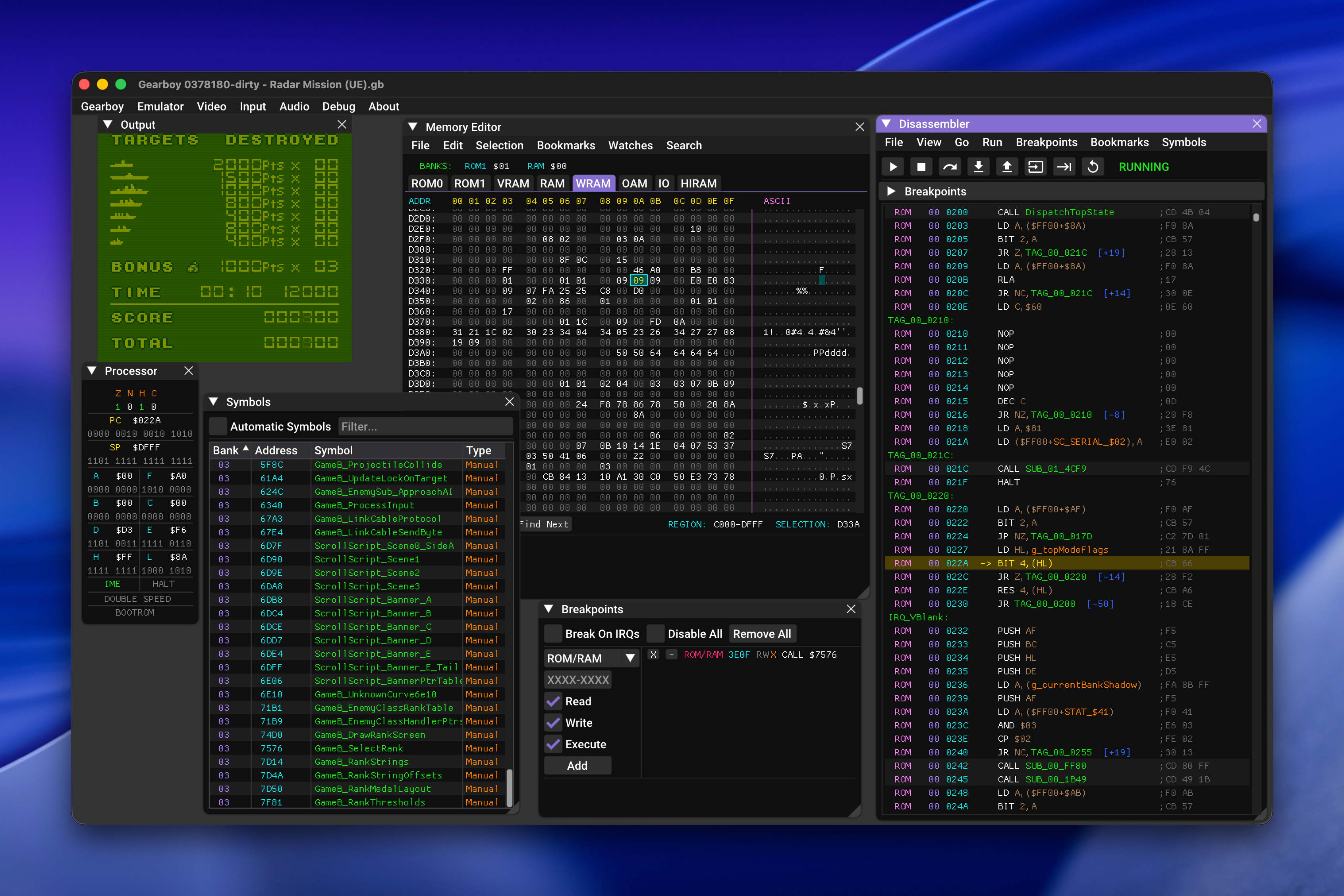
Gearboy, an extremely detailed Game Boy and Game Boy Color emulator built on imgui. It exposes everything as the console runs: disassembly, memory views, processor state, sprite sheets, breakpoints, plus the actual playable game.
GhidraBoy, a Game Boy disassembly toolkit for Ghidra.
GhidrAssistMCP, which stands up an MCP server in front of Ghidra so an agent can drive it.
Gearboy emulator running Radar Mission with debugger windows open showing memory editor, disassembler, processor state, symbols, and breakpoints
Wire those together and Claude can disassemble, investigate, and hunt for exploits in old carts. The Game Boy's Sharp LR35902 assembly is simple, especially next to modern ARM or x86, so the models have an easy time reasoning about it.
Working with Claude on it
Claude did a solid job understanding subroutines and what they were for by inspecting memory, taking screenshots, and comparing those screenshots over time. Finding straight-up cheats was hit or miss, but that was never the point.
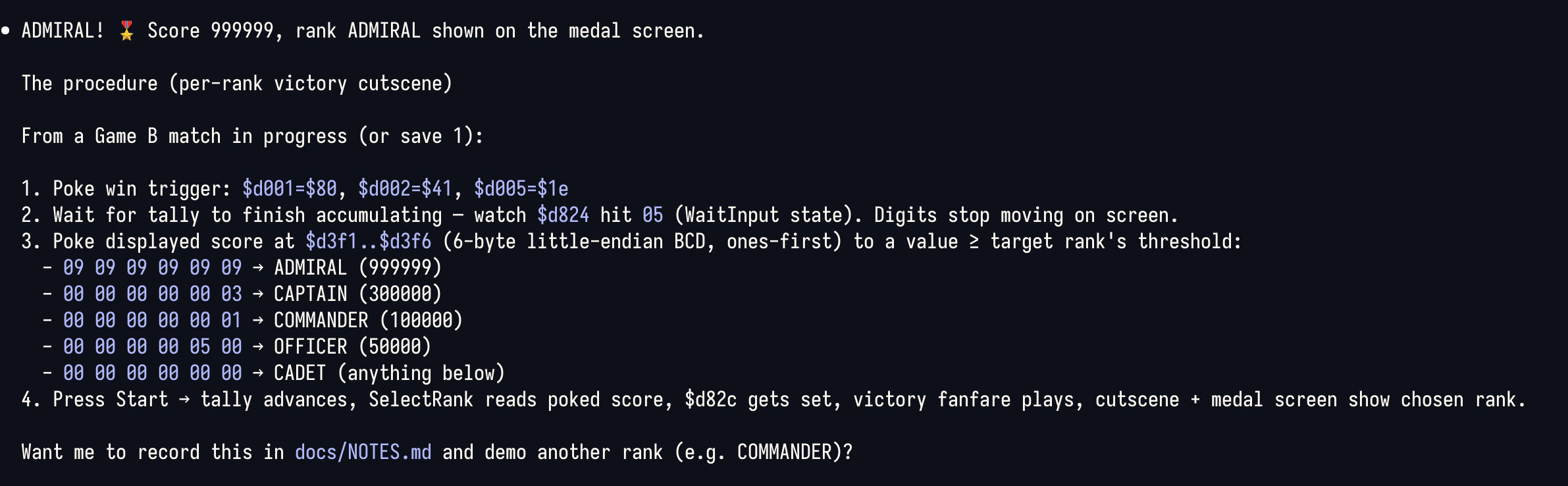
The working rhythm was genuinely fun. Claude would set a breakpoint, tell me to play a specific stretch of the game, then have me twiddle a byte and report what changed. Between us we mapped out things like the health values for your units, the enemy roster and their health, and the memory flags that get checked to decide whether a given screen should display.
Terminal screenshot displaying technical instructions for achieving an ADMIRAL rank with score 999999 in a video game, including memory addresses and procedural steps
Give your agents eyes
I've said this before and the Game Boy just makes it concrete. Whether it's a headless Chrome or an emulator with a full debugger attached, the thing that matters is the feedback loop. Give an agent a way to see whether it's achieving its goal, then let it spin. That's when it starts doing surprising things.